Louis Daguerre
1787–1851 · France
A unique image on a plate.
Explore 3 works ↓Life and work ↓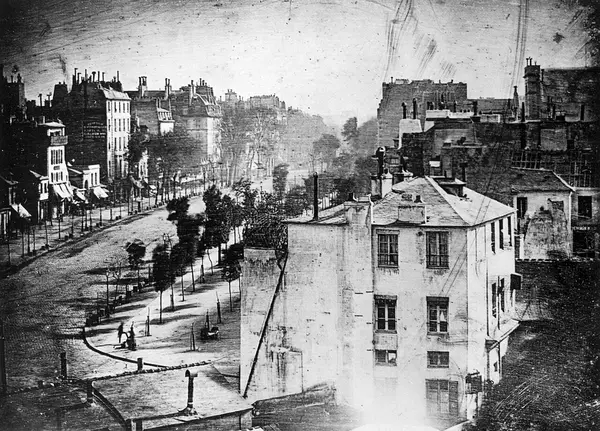
Louis Daguerre · between 24 April 1838 and 4 May 1838 (or possibly 1837)
Domaine public · Reuse conditions · Artwork record
A journey through images.
Available photographs can be enlarged.
Work and source
Referenced work : Nature morte à Jupiter tonnant — daguerréotype de Kynžvart · 1839 · Louis-Jacques-Mandé DaguerreOfficial work ↗Work and source
Referenced work : Intérieur d’un cabinet de curiosités · 1837 · Louis-Jacques-Mandé DaguerreOfficial work ↗Each photograph links to its portfolio or collection record. Titles, dates and credits are retained when supplied by the source.
Fewer than twenty-five surviving photographs are securely attributed to Daguerre. This selection brings together documented works from that very small body of work. Daguerre’s body of work, at the Metropolitan Museum of Art
The story
A painter and creator of diorama spectacles, Daguerre continued the photographic research begun with Nicéphore Niépce. His process, made public in 1839, produced a detailed image on a silver-plated copper sheet. The daguerreotype rapidly transformed portraiture and the circulation of likenesses. Each plate is a unique object: unlike the negative-positive system, it does not allow multiple prints to be made directly from the same exposure.
Understanding the work
Look at the details but also the reflections on the surface: a daguerreotype plate changes appearance with the light and viewing angle. The experience depends on its particular material qualities.
Key works and series
Daguerreotypes; Boulevard du Temple.