Joseph-Philibert Girault de Prangey
1804–1892 · France
The daguerreotype in the service of architecture and archaeology.
Explore 2 works ↓Life and work ↓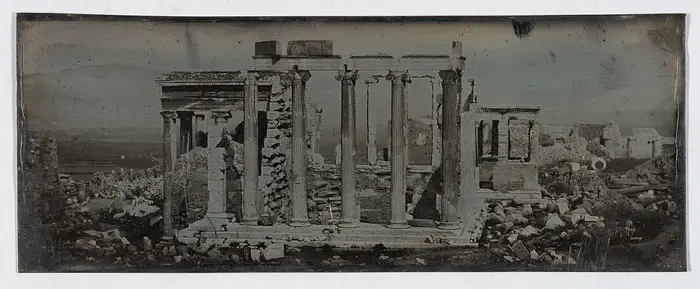
Joseph-Philibert Girault de Prangey · 1842
The Metropolitan Museum of Art · Purchase, Philippe de Montebello Fund, Mr. and Mrs. John A. Moran Gift, in memory of Louise Chisholm Moran, Joyce F. Menschel and Annette de la Renta Gifts, and funds from various donors, 2016 (2016.93)
CC0 — domaine public · Reuse conditions · Artwork record
A journey through images.
Explore the selection at your own pace. Click a photograph to enlarge it, then move from one work to the next.
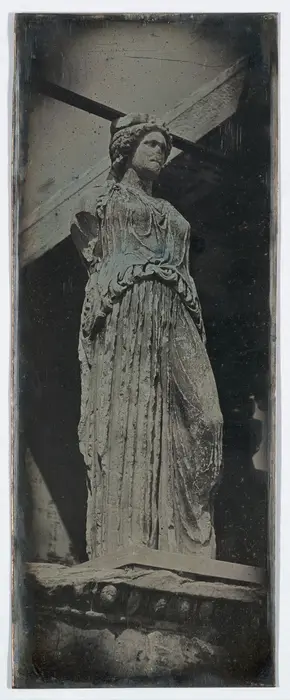
Joseph-Philibert Girault de Prangey · 1842
The Metropolitan Museum of Art · Purchase, Philippe de Montebello Fund, Mr. and Mrs. John A. Moran Gift, in memory of Louise Chisholm Moran, Joyce F. Menschel and Annette de la Renta Gifts, and funds from various donors, 2016 (2016.94)
CC0 — domaine public · Reuse conditions · Artwork record
Each photograph links to its portfolio or collection record. Titles, dates and credits are retained when supplied by the source.
The story
A draughtsman, scholar and traveller, Girault de Prangey adopted the daguerreotype early. His Mediterranean journey, begun in 1842, made the photographic plate a tool for studying monuments. Yet his images go beyond inventory: he adapted the proportions of the frame to each subject and combined architectural description with an exploration of composition. The rediscovery of his archive profoundly renewed our understanding of early photography.
The selection preserved at the Metropolitan Museum of Art allows two works to be examined: Erechtheion, Athens (62. Athènes. 1842. T. de Minerve Poliade.), Caryatid, Erechtheion, Athens (56. Athènes. Caryatides. Erecht.). The records identify the following techniques: Daguerreotype. This information distinguishes the moment of exposure, the process and the preserved object.
Understanding the work
The panorama of the Erechtheion and the caryatid operate at two scales. Notice how the elongated format organizes the first view, then how the sculpted detail almost becomes a portrait.
Key works and series
Erechtheion, Athens (62. Athènes. 1842. T. de Minerve Poliade.) (1842) ; Caryatid, Erechtheion, Athens (56. Athènes. Caryatides. Erecht.) (1842). The museum records specify each print’s process, dimensions, provenance and accession number.