John Adams Whipple
1822–1891 · United States
The daguerreotype between portraiture, invention and research.
Life and work ↓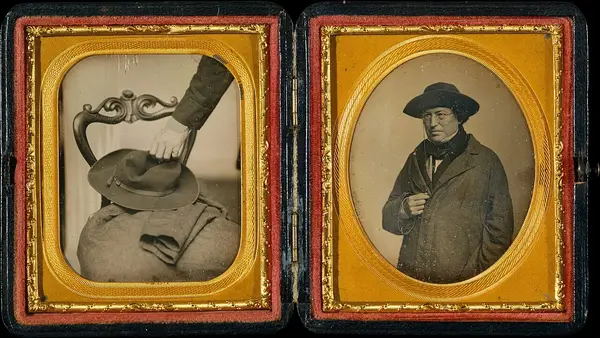
John Adams Whipple · early 1850s
The Metropolitan Museum of Art · The Rubel Collection, Purchase, Lila Acheson Wallace, W. Bruce and Delaney H. Lundberg, and Ann Tenenbaum and Thomas H. Lee Gifts, 1997
CC0 — domaine public · Reuse conditions · Artwork record
The story
John Adams Whipple was an American daguerreotype pioneer and an experimenter in the medium’s early decades. His investigations included astronomical photography. The portrait of Cornelius Conway Felton reveals another aspect of his practice: the photographic object presented in a case, with its frames and arrangement of multiple views. The history of these images cannot be separated from their material support.
The selection preserved at the Metropolitan Museum of Art allows one work to be examined: [Cornelius Conway Felton with His Hat and Coat]. The records identify the following techniques: Daguerreotype. This information distinguishes the moment of exposure, the process and the preserved object.
Understanding the work
Look at the difference between the two poses and the role of the hat. The case and borders are more than decoration: they organize the way the portrait is preserved, held and shown.
Key works and series
[Cornelius Conway Felton with His Hat and Coat] (early 1850s). The museum records specify each print’s process, dimensions, provenance and accession number.