Ernest Eugène Appert
France
Photomontage and the political uses of photography.
Explore 2 works ↓Life and work ↓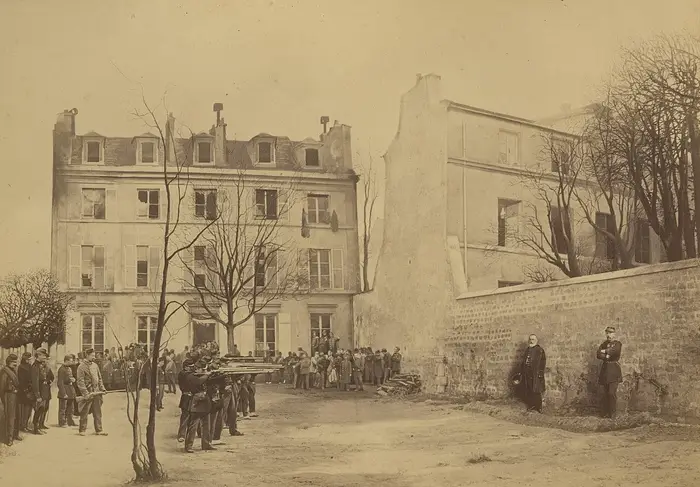
Ernest Eugène Appert · 1870–71
The Metropolitan Museum of Art · Joyce F. Menschel Photography Library Fund, 2012
CC0 — domaine public · Reuse conditions · Artwork record
A journey through images.
Explore the selection at your own pace. Click a photograph to enlarge it, then move from one work to the next.
Ernest Eugène Appert · 1870–71
The Metropolitan Museum of Art · Joyce F. Menschel Photography Library Fund, 2012
CC0 — domaine public · Reuse conditions · Artwork record
Each photograph links to its portfolio or collection record. Titles, dates and credits are retained when supplied by the source.
The story
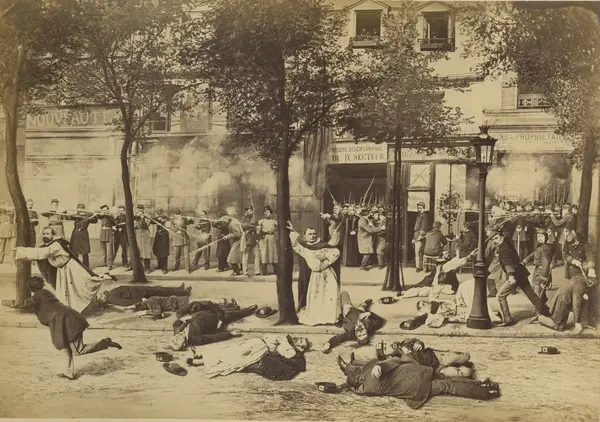
Ernest Eugène Appert is associated with images of the events in Paris in 1871. His series Crimes de la Commune uses photomontage to reconstruct scenes of violence. These works are essential to a critical history of the medium: their photographic appearance does not guarantee that the scene took place before the camera. Montage and caption here support a political narrative hostile to the Communards.
The selection preserved at the Metropolitan Museum of Art allows two works to be examined: Photomontage : Assassinat des généraux Clément Tomas et Jules Lecomte, rue des Rosiers 6 à Montmartre deans la journée du 18 mars 1871, Photomontage : Massacre des dominicains d'Arcueil, route d'Italie no. 38, le 25 mai 1871, à 4 heures et demie. The records identify the following techniques: Albumen silver print from glass negative. This information distinguishes the moment of exposure, the process and the preserved object.
Understanding the work
Identify the frozen poses and differences in scale between figures. Read these images as constructions of propaganda, not as direct photographs of the events they claim to show.
Key works and series
Photomontage : Assassinat des généraux Clément Tomas et Jules Lecomte, rue des Rosiers 6 à Montmartre deans la journée du 18 mars 1871 (1870–71) ; Photomontage : Massacre des dominicains d'Arcueil, route d'Italie no. 38, le 25 mai 1871, à 4 heures et demie (1870–71). The museum records specify each print’s process, dimensions, provenance and accession number.