Edward Anthony
1818–1888 · United States
The New York street and the experience of stereoscopy.
Explore 2 works ↓Life and work ↓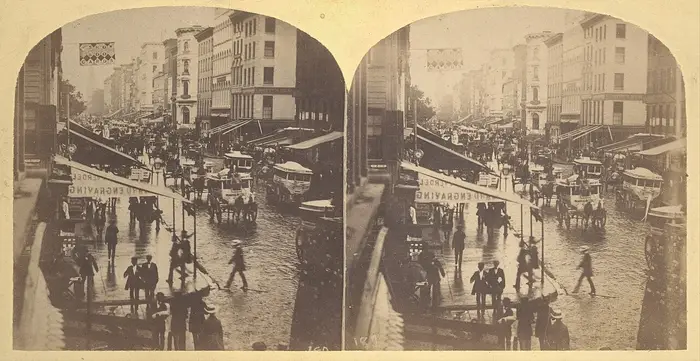
Edward Anthony · 1859
The Metropolitan Museum of Art · Warner Communications Inc. Purchase Fund, 1980
CC0 — domaine public · Reuse conditions · Artwork record
A journey through images.
Explore the selection at your own pace. Click a photograph to enlarge it, then move from one work to the next.
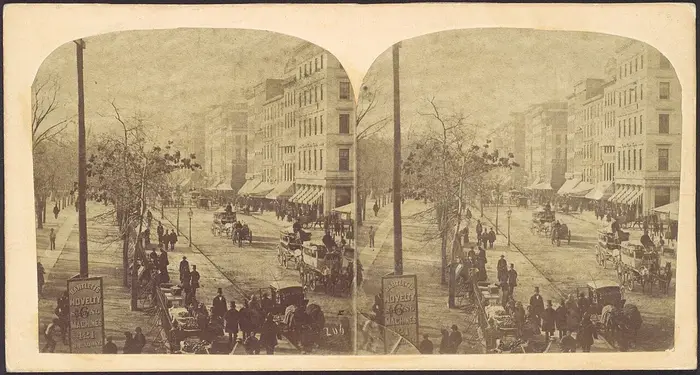
Edward Anthony · ca. 1860s
The Metropolitan Museum of Art · Warner Communications Inc. Purchase Fund, 1980
CC0 — domaine public · Reuse conditions · Artwork record
Each photograph links to its portfolio or collection record. Titles, dates and credits are retained when supplied by the source.
The story
Edward Anthony participated in the development of the American photographic industry and the distribution of stereoscopic views. His photographs of Broadway show a city in motion, crossed by pedestrians and carriages. Their double format was designed to produce an impression of depth with a suitable viewer. The photographic object is therefore connected to a particular way of looking.
The selection preserved at the Metropolitan Museum of Art allows two works to be examined: Broadway on a Rainy Day, [Broadway with horse-drawn carriages]. The records identify the following techniques: Albumen silver print. This information distinguishes the moment of exposure, the process and the preserved object.
Understanding the work
Compare the two halves of each card: they are not simply copies. Then observe traffic, shadows and the differences between wet and dry road surfaces, which give the scenes their rhythm.
Key works and series
Broadway on a Rainy Day (1859) ; [Broadway with horse-drawn carriages] (ca. 1860s). The museum records specify each print’s process, dimensions, provenance and accession number.